The story of One World is ultimately the story of the people who have been part of it.
Throughout our anniversary year, we’ll reconnect with students, parents, educators, and other members of the One World community from across the past two decades. We’ll hear where their journeys have taken them—from college and careers to classrooms, businesses, and community leadership—and explore the role writing, confidence, and finding their voice played along the way.
Twenty years. Thousands of voices. And many more stories still to be written.
- Kamari Hunter Mayes
- Ben Acquah
- Matt Kaufax
- Santino Hebert
- Quisan Adams
- Andrew Hinshaw
- Aliyah Ibikunle
- Arianna Ashton
- Marisol Castillo
- Bianca Garner-Smith
Kamari Hunter Mayes
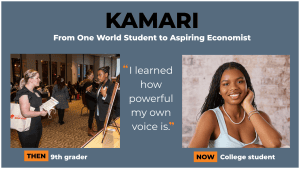 When Kamari joined One World Education as a ninth grader, she was looking for ways to strengthen her resume. She didn’t expect to discover a skill that would shape her future.
Through One World, Kamari researched and presented on issues that mattered to her, including social media’s impact on teenage body image and the school-to-prison pipeline. Along the way, she found her confidence as a writer and public speaker. “One World showed me that knowing how to communicate and present yourself is a skill that can generate opportunities,” Kamari says. “It helped me realize how powerful my own voice is.”
After winning One World’s presentation competition both years she participated, Kamari went on to graduate as one of two Black valedictorians in her high school class and earn a full scholarship to Hampton University. There, she plans to study Economics and Finance, with hopes of one day working in monetary policy.
Looking back, Kamari says One World gave her more than presentation skills—it gave her confidence in herself. Her advice to current students is simple: embrace every opportunity to learn. “The ability to communicate is very powerful,” she says. “It’s going to open so many doors—not just in school, but for the rest of your life.”
Ben Acquah
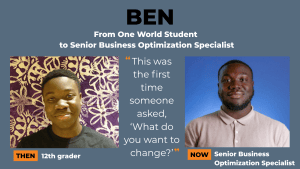 When Ben joined One World Education as a high school senior, he expected another school assignment. Instead, he was asked a question that changed his perspective: “What do you want to change?”
Ben chose to advocate for expanding financial aid opportunities for undocumented students, an issue that was deeply personal to him.
After graduating high school, Ben returned to One World as a Program Manager and later volunteered with the One World Academy, helping other students find that same sense of purpose.
“Once it clicks that they can actually talk about something they care about, you see the passion come alive,” he says. Seeing former students years later and hearing how the program impacted them remains one of his most meaningful experiences.
Today, Ben works on Nestlé’s Supply Chain Optimization team, where the communication and storytelling skills he developed through One World remain central to his work. Looking back, he describes One World as “a springboard and a catalyst”—an experience that gave him confidence to speak out and inspired him to keep learning, listening, and advocating for the issues that matter.
Matt Kaufax
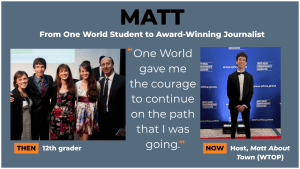 As a high school student, Matt Kaufax never imagined that a One World scholarship essay would help launch his career.
After writing about animal cruelty, Matt was selected as a scholarship finalist and, through One World’s partnership with TEDx, transformed his essay into a TED Talk. He calls the experience “the catalyst” for much of what followed.
Today, Matt is the creator and host of Matt About Town for WTOP, telling stories about the people, places, and hidden history of the Washington region. His award-winning work combines journalism, digital storytelling, and a passion for connecting communities through stories that educate, inspire, and bring joy.
Matt credits One World with strengthening his writing and public speaking while giving him confidence that his ideas were worth sharing. Even when his career path became uncertain, he says the confidence and determination he developed through One World stayed with him. Looking back, he describes One World as a source of “lifelong encouragement” that helped him discover his voice and gave him the courage to pursue a career in journalism.
Santino Hebert
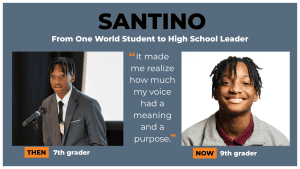 As Santino prepares to begin ninth grade at Friendship Technology Preparatory Academy, he’s focused on basketball, academics, and becoming a stronger leader on and off the court. His experience with One World helped give him the confidence to speak up—and showed him the power his words could have.
“It made me realize how much my voice had a meaning and a purpose,” Santino says.
That confidence has already opened new doors, including an opportunity to speak before the DC Council. This year, he’s looking forward to being a leader to his basketball teammates, which is something that One World has helped with too. “Communication is a big part of basketball,” he says.
Santino’s advice to current One World students is simple: trust yourself.
“You have to believe in yourself that you are able to do this.”
Quisan Adams
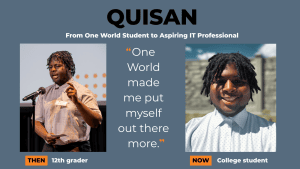 When Quisan Adams joined One World as a student at DC International, he initially saw it as a chance to earn community service hours and try something new. Giving his first speech on stage was nerve-racking, but he pushed through.
That experience stayed with him. Today, Quisan is studying information technology at the University of the District of Columbia, exploring cybersecurity, and pursuing professional opportunities in the field. He says One World helped him become more willing to step into unfamiliar situations and put himself out there.
His advice to current students reflects that growth: even when you’re unsure you belong, take the chance and show up anyway.
Andrew Hinshaw
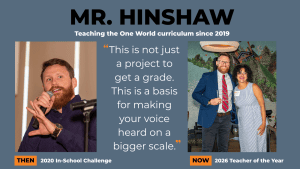 Andrew Hinshaw has taught English as a Second Language at Carlos Rosario International Public Charter School for 10 years and has used One World Education with his students since 2019. Over the years, he has watched students grow as writers, speakers, researchers, and advocates, often discovering how much they care about the issues they choose to explore.
For Andrew, the impact lasts well beyond the final presentation.
Former students still tell him they keep their One World books and use the skills they learned in college, at work, and in their communities.
“Each year when I see students from the past, I get one more story of how the project has helped them,” he says.
That lasting sense of empowerment is what makes the program meaningful to Andrew: One World gives students the tools and confidence to make their voices heard—not just for an assignment, but for the rest of their lives.
Aliyah Ibikunle
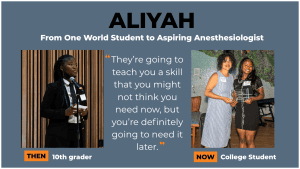 Aliyah first participated in One World as an eighth grader, researching clandestine racism in urban education and earning first place in the One World Challenge. She returned as a high school sophomore to explore the school-to-prison pipeline, earning second place.
When Aliyah started One World, public speaking made her nervous. Through writing, research, and presentation practice, she gained confidence in speaking up for herself and the issues she cares about. Those skills have since helped her with college and scholarship interviews and inspired her to advocate for issues affecting her community.
Her advice to future One World students? “They’re going to teach you a skill that you might not think you need now, but you’re definitely going to need it later.”
After graduating from McKinley Technology High School, Aliyah earned a full-tuition scholarship at Temple University, where she plans to pursue a pre-med track with the goal of becoming an anesthesiologist.
Arianna Ashton
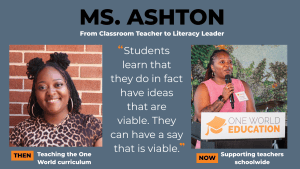 Ms. Arianna Ashton serves as a literacy specialist at Capital City Public Charter School, where she coaches the humanities team and supports teachers implementing the One World curriculum. Having first used the curriculum during her own early years of teaching, she was excited to introduce it to more classrooms because she knew what it could offer students as an entry point into formal writing.
While implementing the One World curriculum, Arianna watched students become stronger writers and more confident presenters. As students shared their experiences and listened to their peers, they also developed greater empathy for one another.
“Their classrooms became safer spaces for students to express themselves and talk about their individual experiences,” Arianna said.
For Arianna, One World’s impact reaches beyond the classroom, helping students recognize that their ideas matter and giving them skills to advocate for themselves and their communities.
Marisol Castillo
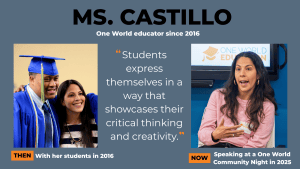 Ms. Marisol Castillo first started teaching the One World curriculum to high schoolers at E.L. Haynes in 2016. Nearly a decade later, it remains a part of her teaching.
What stood out from the beginning was how One World made the writing process transparent for students—from understanding key vocabulary and evaluating sources to considering their audience and building an argument step by step.
“It’s changed the way I teach argumentative essays,” she says. “You start paying attention to every detail… It brings up all of these questions that you can explore with students that allow them to see how complex writing can be.”
But the most memorable moments come when students choose issues they genuinely care about. She has watched otherwise reluctant students revise essays months after a unit ended, seek out extra feedback from peers, and take pride in becoming published writers.
“There’s been a lot of moments like that where you see kids really rise to the occasion.” That’s why she keeps coming back to the curriculum year after year.
Bianca Garner-Smith
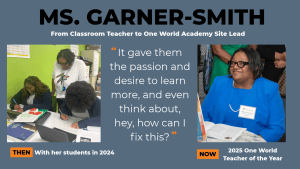 In her 25 years as an educator, Bianca Garner-Smith (affectionately known as Ms. GS) has seen firsthand how writing can build students’ skills and confidence. Now in her third year teaching One World at Ingenuity Prep, she also serves as site coordinator for the school’s new afterschool One World Academy.
One of her proudest moments was watching her first One World student take the stage to deliver her speech at the One World Challenge. The following year, five students participated, gaining experience researching, writing, and presenting their ideas. In 2025, Ms. GS was named One World’s Teacher of the Year.
She especially enjoys watching students engage deeply with their topics. As Ms. GS says, “It hits different when it’s a topic they’re passionate about.”
For Ms. GS, the program’s greatest value is helping students recognize their ability to make a difference while developing skills they can carry into the future.
“Getting the exposure early and being able to go to high school with those skills … It’s invaluable.”